
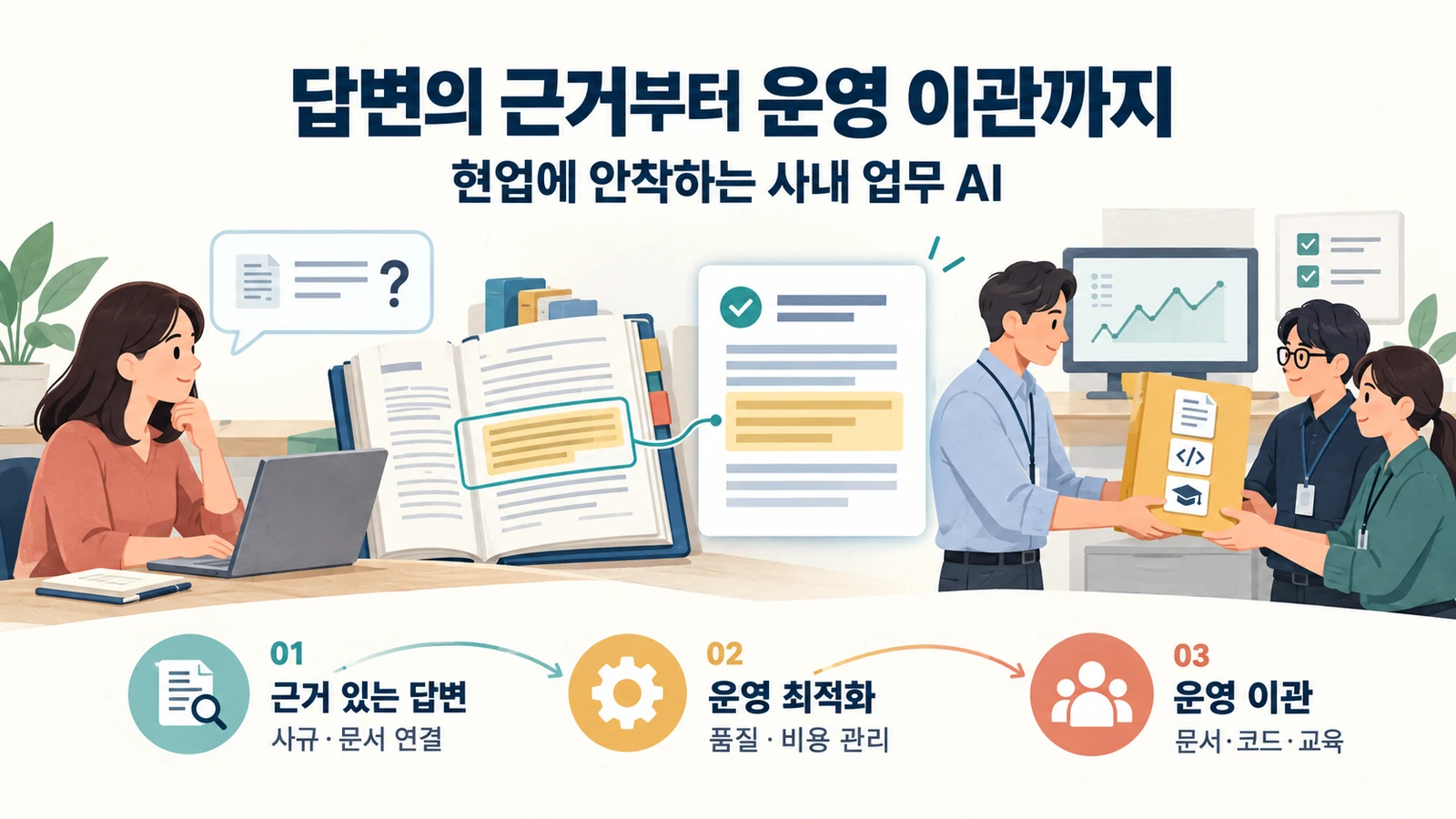
AI that supports in-house work must find relevant evidence in regulations and business documents, provide answers, and be utilized in accordance with the user's authority and actual work procedures. Even after construction, it is important to have a structure that continues document updating, quality review, cost management, and operational transfer.
How do you create a grounded answer?
Search augmentation generation (RAG) is an approach that retrieves documents related to a question and uses them as the basis for an answer. It is designed to link the document version with the corresponding clause and lead to confirmation by the responsible department in cases where there is insufficient evidence or interpretation is required.
Sample question: “Please tell me the proof and approval process required to settle travel expenses.” The answer includes information on applicable regulations, reference points, and confirmation procedures. This question is for illustrative purposes only and does not represent the actual regulations of any particular client company.
From construction to operation transfer
| step | main task |
|---|---|
| build | Document organization, authority/security scope, search and evidence connection, field review flow design |
| Operation Optimization | Evaluation queries and regression testing, error, cost and delay monitoring, document and model change management |
| Operation transfer | Operation manual, code/configuration, test data and failure response procedures, training for personnel |
Under what conditions is performance confirmed?
Base your answer Compare suitability, error handling, processing time and operational costs with established evaluation data. The model/document version, question type/sample, base period, and included costs must be recorded together to interpret the results.
Cost management methods such as semantic cache are applied considering data changes and answer update conditions. We do not guarantee a specific cost reduction rate or answer accuracy regardless of the adoption environment.
Materials to be inherited by the operating organization
- Document upload/update and re-indexing procedures
- Evaluation questions/expected answers and quality regression testing
- Information on accounts, permissions, distribution, recovery and failure response
- Monitoring standards for cost, delay, and user feedback
How are the roles of GLT and partners divided?
| area | Role in collaboration |
|---|---|
| GLT Korea | Summary of company regulations, work processes and results review standards, inspection and operation transfer requirements for each business scenario |
| AI technology partners | Design and implementation of AI model, agent, and platform, and model evaluation and operation technology |
| Customer company/operating organization | Data use rights, business review, application approval and operating policy |
The table above divides the areas of collaboration, and the actual scope of performance and output for each project is confirmed according to the contract and division of work.
Disclosure and scope of explanation
Introduction to Serendex Public ProjectIntroduces a case of a global home appliance manufacturer's in-house business AI construction, technical support, and operation transfer, as well as the participation of MSP partner positions.
This article explains the application structure based on the published examples and the domain perspective of GLT. Each customer's contract period, inspection results, and quantitative performance are provided separately from the technical description on this page.