Solution/GAADMGAADM / Governed AI Agent Development Methodology
In the implementation of AI, Adds human judgment and evidence.
We organize project materials and scope of work, and connect them from execution of Claude Code/Codex to build/test, verification of evidence, and human acceptance. This is a development management solution that applies controlled AI agent development methodology to actual work.
GAADMAI Agent Development ManagementGLT KOREA / SOLUTIONS
GAADM / AVAILABILITY & INTEGRATION
See what features we have implemented and how much we are ready to deliver.
Core flow verification for development completed, function expansion and release in progress
01
Currently implemented and verified functions
We connected the project with Context Pack, Work Order/Approval, Claude Code/Codex execution, isolated build/test, and documentation/human acceptance. Document creation, publication, export, knowledge search, MCP, and backup and restoration were also implemented.
02
Pilot application/connection review
In one representative task, we check everything from data preparation to verification and acceptance. Existing storage and work tools, AI use policy and data transmission scope, roles in charge, and application environment are determined together.
03
Advancement and preparation for release
The full semantic tracking of requirements, design, and testing, team collaboration, and releases and KPIs are subsequent extensions. Operation certification/signature, license, and distribution method are confirmed during the launch preparation stage.
04
Experience public status
Preparing for public experience
We have completed implementation and verification of the core development flow, and are in the process of expanding functions and preparing for release. The current homepage provides an introduction and actual verification screen. Public download/online execution experience and delivery schedule will be announced after preparation.
The current verification was performed based on development roles/signatures and controlled example projects. The authentication, authority, and data protection of the customer's operating environment and the actual scope of application are separately confirmed.
GAADM / METHOD & SOLUTION
People set standards, Make AI execution a verifiable task.
GAADM is a Governed AI Agent Development Methodology, that is, a controlled AI Agent development methodology. It specifies the work to be done by AI and connects it to execution, verification, and acceptance procedures while maintaining quality responsibility for each step of the project and human quality.
The methodology covers the project, sprint, and agent work cycles together. GAADM PMS, which supports this, has implemented the core flow of current work units and is expanding team and release management and overall tracking capabilities.
GAADM / WORKFLOW & SCOPE
From the start of work to human acceptance.
First determine the basis for the work and the allowable range of changes and then execute them. Inspection failures lead to supplementation and re-approval, and are the difference between successful implementation and final human acceptance.
01Projects
Select the target repository and the source/document required for the task.
02Context Pack
Bind your work by anchoring references and versions.
03Work Order
Set goals, files allowed for modification, completion conditions, and inspection commands.
04human approval
Review and approve work scope and execution/verification plan.
05Run Agent
Claude Code·Codex creates a change plan and applies it to a separate space.
06Verification Gate
Check build and test results and classify failure, interruption, and non-execution.
07Evidence
Link changes, execution history, and verification/approval basis.
08acceptance of people
Results and evidence are reviewed and accepted or supplemented with a new revision.
GAADM / IMPLEMENTED CAPABILITIES
Main functions currently implemented and verified.
01
Project knowledge and context pack
Search documents by keyword, meaning, and relationship, and pin the selected citation source and version to Context. You can check the necessary evidence for each task.
02
Work instructions and approvals with a clear scope
Manage the purpose, allowable path, completion conditions, and inspection commands with Work Order. Changes and retries are subject to a new revision and re-approval.
03
Execute in isolation from Claude Code·Codex
Choose from two AI tools to create change plans and execute and validate them in a space separate from the original. Even after acceptance, reflecting the original is a separate procedure that reviews before and after changes.
04
Actual build/test and installation traces
Records actual commands and results in a Node.js 24 environment. It installs without a network with a fixed cache of public npm, and distinguishes failures, timeouts, and interruptions from success.
05
Document preparation and publication and output of output
Manage document drafts, versions, reviews, and publications, and pin publications to context. Export documents and work traces to Markdown, HTML, JSON and Word, PDF and Excel.
06
Verification basis and recovery history
It links task, execution, gate, and acceptance records and verifies their integrity with a hash and signature for development. Provides recovery of changed files and encrypted backup/restoration of the entire runtime/project.
GAADM / INPUTS & OUTPUTS
What results will the materials you prepare lead to?
Work inputs and outputs confirmed in pilot
review area
Input to prepare
Results to check
basis of work
Project sources/reference documents, publications and selected search citations
Context Pack with fixed version
Task/execution plan
Purpose of work, acceptable files, completion conditions, roles and approval plan
Approved Work Order and Revision History
Verification Plan
Build/test commands, dependency locks, and necessary execution environment
Actual exit code/log, installation receipt and Gate result
Acceptance/Output
Details of changes, traces of implementation and basis for human judgment
Records of acceptance and rejection, documents, work packages and recovery records
Currently, build and test support Node.js 24/npm and a fixed cache based on public npm lock. After checking the environment, package, and input size limitations, determine the pilot range. Full requirements tracking/operational release automation and other language environments follow.
GAADM / VERIFIED SCREENS
Check the flow with the actual verification screen.
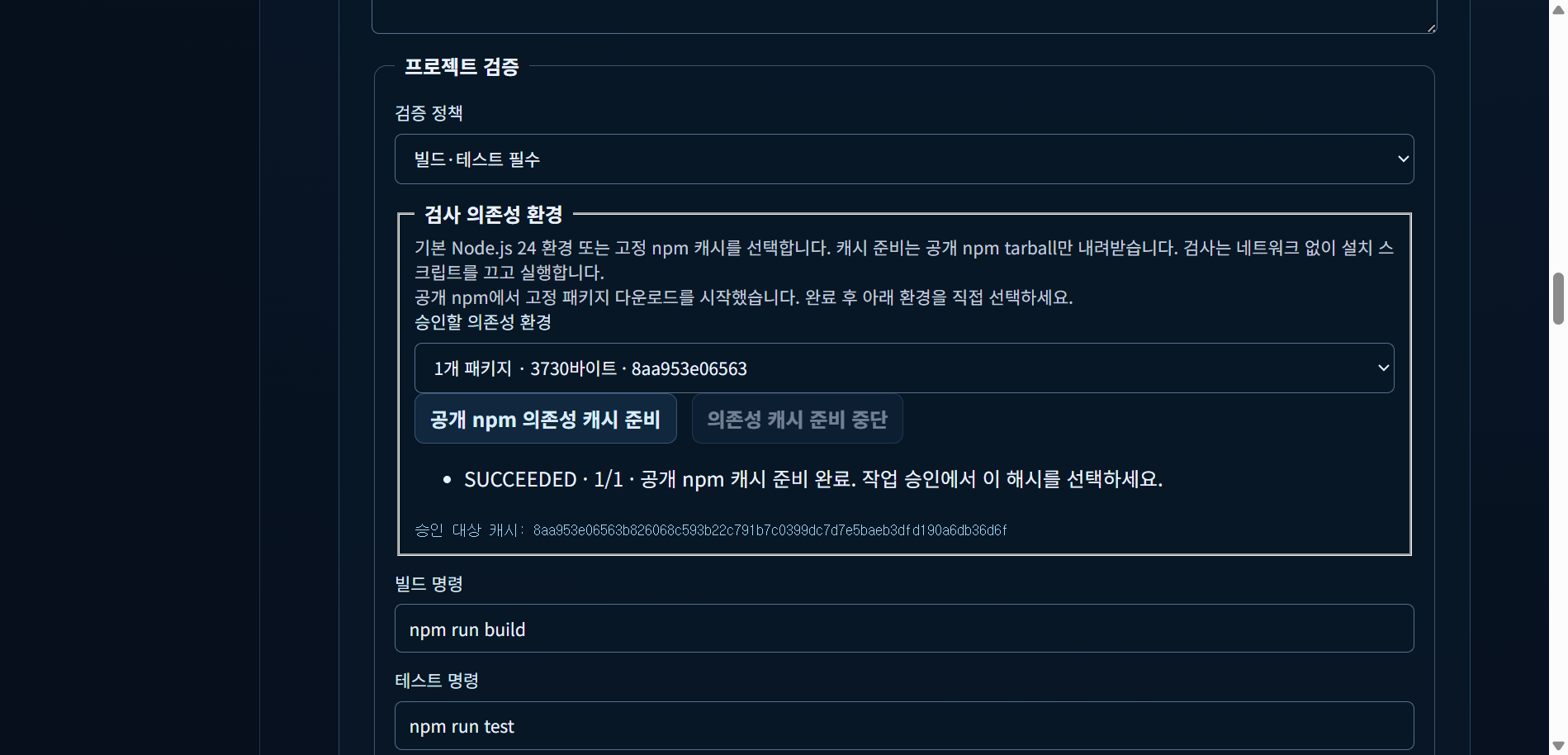
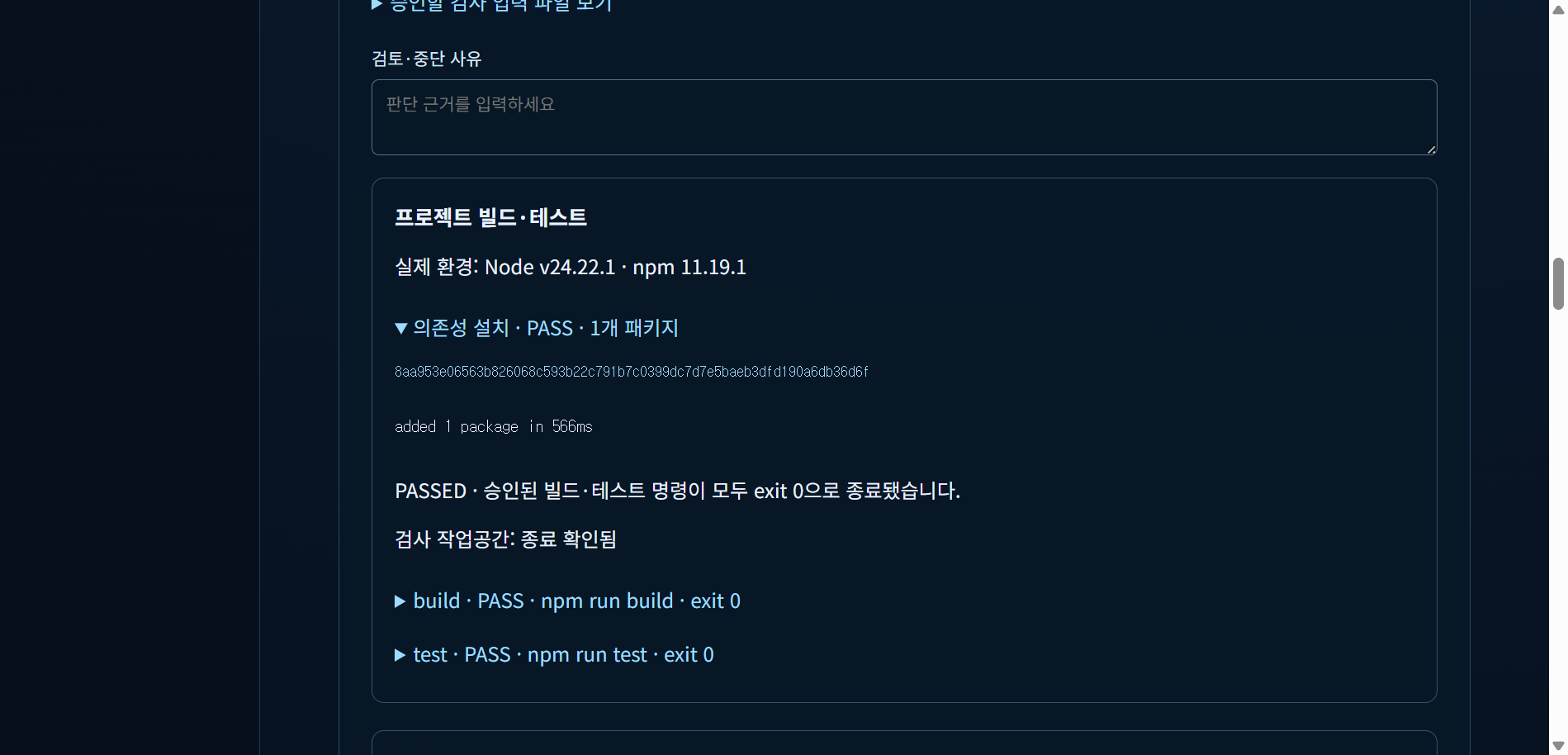
This is the dependency environment selection and actual build/test results confirmed in the example project for development. This is not customer operational data or online live experience screens.
Select your inspection environment and static cache and confirm the hashes you want to accept. Verification environment for development · Example data. Click on the image to see it larger.
Original Korean source material. See the English explanation on this page.
Check actual installation, build, and test results and exit codes. Verification environment for development · Example data. Click on the image to see it larger.
Original Korean source material. See the English explanation on this page.
Data standards: GAADM methodology introduction material and GAADM PMS implementation and verification record as of October 23, 2026. We have organized the proposed scope of the methodology and the current product features.
GAADM / BEFORE YOU START
Before applying GAADM Please check any questions you may have.
We check the AI use policy, project data, verification environment, and provision status, and determine the scope of application starting from small tasks.
What is the relationship between GAADM methodology and solutions?+
GAADM is a development methodology in which humans determine intent, scope, and acceptance criteria and verify and approve AI execution. GAADM PMS is a solution that implements the process through task, execution, and traceability management, and is currently at the stage of implementing and verifying the core flow of the work unit.
We currently select two tools to create change plans and connect them to actual execution and verification flows. Accounts for installing and using tools and the allowable scope for AI transfer of project materials are confirmed before piloting.
The current homepage provides solution introduction and actual verification screen. We are verifying the core flow for development and expanding functionality, but public downloads and online experiences are not yet available. Pilot objectives and application conditions will be reviewed during the consultation.
What execution environments and projects are supported?+
The current solution consists of a Local Runtime separate from the Electron desktop app. In-product build/test supports Linux Node.js 24/npm and public npm lock-based cache. Other language/package managers, private repositories and bulk input are follow-up scope.
Does AI directly change the operating system or original?+
Work results are verified in a space separate from the original. Reflection of the original is a separate procedure to check before and after changes after a person accepts them. Currently, approval roles and trail signing are implementations for development purposes, while operational authentication, signing, and authorization policies are finalized prior to launch and customer deployment.
What data and standards are needed for introduction review?+
Prepare small representative tasks, related sources/documents, scope of modification, acceptance criteria, and build/test commands. Measure effectiveness by comparing work time, human review, and rework with existing methods. The period, cost, and scope of provision are determined after confirming the conditions of connection with the pilot.
How do we apply the execution and verification flow of AI development to our organization?
Please tell us the scope of work, human approval, build and testing criteria. Review the scope of connection with the existing development environment.
Please choose a situation that is close to our company.
Having these materials will be helpful in your review.
Representative development tasks
Storage/Build/Test Environment
Approval/acceptance criteria
Even if you don't have any data yet, you can tell us about your current situation. Information that is difficult to disclose may be reviewed as a sample with identifying information masked.
In consultation, the scope is set as follows.
Check current work and improvement goals
Summary of data/constraints and comparative verification scope
Link to existing systems and discuss scope of construction