Company I: Finding the Right Mix of Dedicated and Hired Vehicles
A fleet planning case comparing daily orders and vehicle costs to evaluate the mix of dedicated and hired vehicles. The source describes the 30-day simulation assumptions and recommended fleet size.
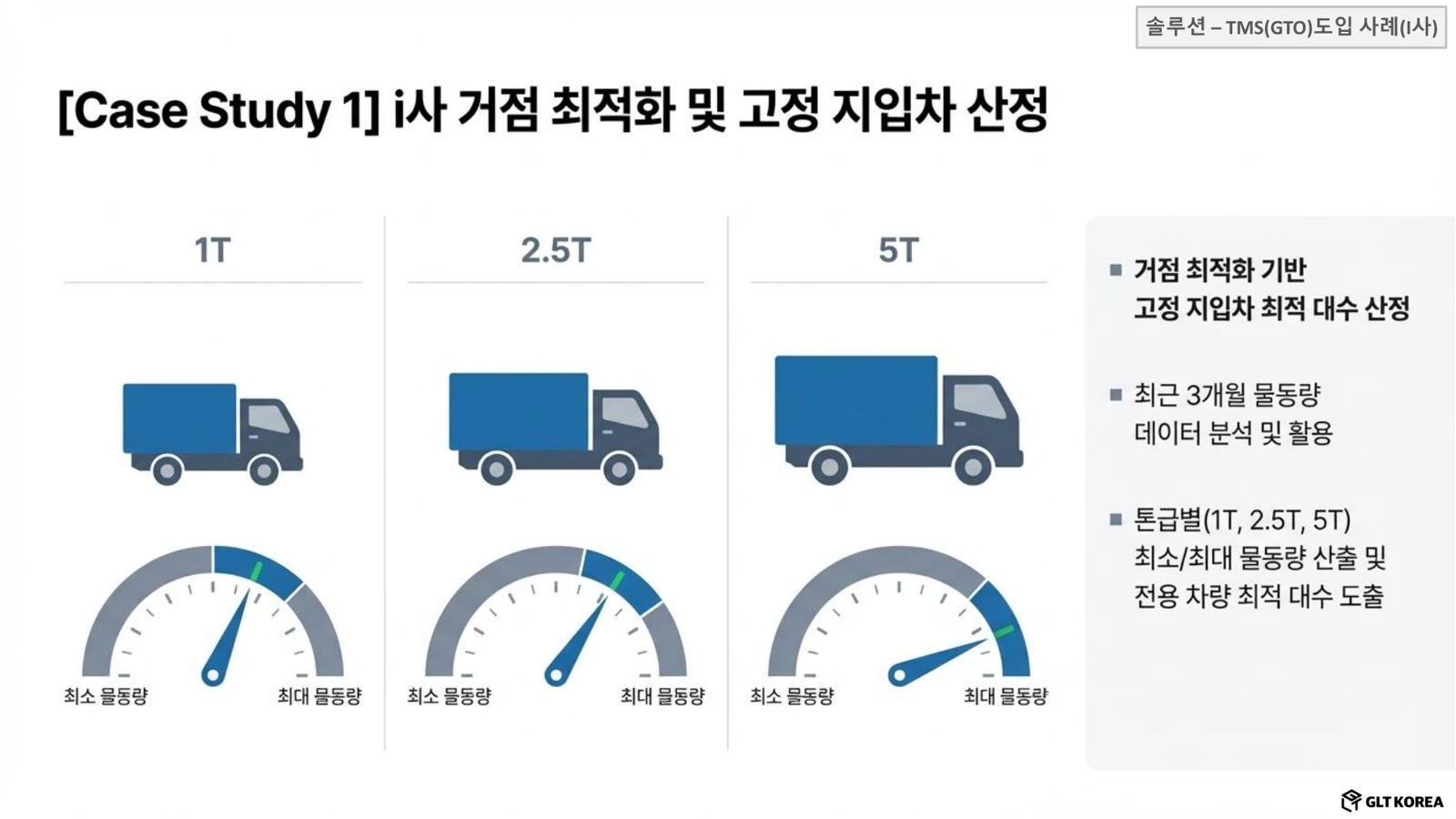
This is the vehicle configuration analysis concept on page 67 of the GLT Solution Introduction (2026). The recommended values below are the results based on separate simulation conditions.
Original Korean source material. See the English explanation on this page.
Costs for dedicated vehicles are incurred even on days when there is a low volume of vehicles, and rental vehicle costs may be added on days when there is a shortage of vehicles. Company I's case is an optimized TMS implementation that reviewed vehicle configuration by comparing dispatch on multiple days based on facility/order and freight rates for each vehicle type.
Operational challenges and scope of GLT implementation
The introductory material explains facility master registration/change, order change/copy/creation, scenario storage, daily dispatch results, and vehicle requirement analysis. The scope of application of GLT is the construction of such transportation and network simulations and result reports.
Compare cost alternatives by storing dispatch results by date and the number of units required by tonnage level
Target of recommended results
Deokpyeong Center’s 30-day simulation
operating assumptions
No multi-rotation of vehicles, use of 3.5T commercial vehicles when there is a shortage of vehicles
Recommendation results recorded in the introduction
Category
Simulation Recommended Algebra
3.5T dedicated vehicle
11th generation
5T dedicated vehicle
37 units
The above values are recommendation results based on specific input, fare, and operating assumptions in the referral. It does not mean the actual number of units purchased or deployed or the optimal number for all customers. We did not add cost reduction rates for which the raw data was not presented separately.
What can you check?
Cost difference between dedicated vehicles and commercial vehicles due to volume fluctuations
Impact of center relocation or addition or change of departure center
Transportation/delivery order division and cross-docking scenarios
Load·Stop·Shipment and vehicle composition results by date
Source and screen range
2026 Introduction Pages 67-69 · 2025.10 Introduction Pages 32-37. The screen below is a previously constructed version of the introduction. The separate vehicle configuration and cost displayed on the screen and the recommendation results in the text are not considered to be the same execution result.
CASE / COMPARISON RECORD
Company I vehicle composition/comparison conditions verification table
We have summarized the simulation conditions and recommended results found in the introduction material. We look at whether the current plan and the alternative have the same conditions, and check the scope of cost reduction and operational measurements.
Recommendation results are based on data verification. Verification of performance under the same conditions is not complete.
The recommended logarithm and some operating assumptions for the 30-day simulation are identified in the introduction. Original results and actual measurement data by current number, pre- and post-cost, and order were not provided, so the number of vehicles reduced and the cost reduction rate were not calculated.
Analysis length of recommendation results30 daysStart and end dates are not provided.
Recommended Fixed Car Total48 unitsTotal of 11 3.5T + 37 5T
Operational measurement performanceunconfirmedDistinguish between simulation recommendations and actual operational results
Scope of confirmation of introduction materials and items required for comparison under the same conditions
Verification items
Current/standard plan
Alternative/recommendation
Confirmation scope and remaining conditions
comparison period
Start and end dates for calculating current costs and operations are not stated.
Indicated as 30-day data simulation on page 69 of the introduction.
The description of the most recent three-month volume analysis on page 67 is separate from the 30-day analysis on page 69. The connection between the two periods and their dates before and after are unknown.
Order/transportation volume
Order ID list, number of items, weight, volume and service target are not disclosed.
Input/assignment result files for each order and daily volume are not provided.
It has not been confirmed whether it is the same set of orders or whether there are order splits/consolidations or omissions.
Vehicles/Resources
The current number of dedicated vehicles, capacity by vehicle type, and daily rental vehicle input amount are not stated.
Page 69 Recommendation: 11 3.5T dedicated vehicles, 37 5T dedicated vehicles. A total of 48 units.
The 48 is the sum of the published figures and not a reduction. The 1T, 2.5T, and 5T analysis explanations on page 67 are not combined with the raw data for each vehicle type in the recommendation on page 69.
operational constraints
The settings for each constraint applied in the current plan have not been disclosed.
On page 69, the policy excludes multi-turn vehicles and uses 3.5T commercial vehicles for the shortfall.
It is unconfirmed whether the remaining restrictions, such as delivery time, loading limit, operation time, and access limit, are equally applicable to the current plan.
Freight/cost range
Fixed car contract fee, operating variable cost, rental car freight and cost ledger not provided.
The unit price table, calculation details, and total cost figures in the recommendation are not stated.
It is necessary to additionally check whether the cost has been converted to the same period and unit and the inclusion criteria for tolls, waiting, round trip, and value-added tax.
Results/Formula
Same conditions, current total cost and no units.
Check only the number of recommended dedicated vehicles. The original graph does not have cost amounts and comparison values.
The number of vehicles reduced and the cost reduction rate were not calculated. The formula below is a definition for re-verification and has not been confirmed as the original engine formula.
Services/Omissions
Non-allocation, cancellation, delayed delivery, and additional processing details not provided.
Results and violation details for each order of the same item are not provided.
Even if costs are lower, you need to determine if this is due to missed orders or relaxation of constraints. Equivalent service levels have not been verified.
Execution/reproducibility conditions
The method of creating the standard and the record of its execution are not provided.
Engine version, input version, operation limit, termination condition, and repeat execution record not stated.
It is not used as data to prove the performance of the current engine or the reproducibility of the same results.
Actual measurement
Actual operation/settlement comparison data and measurement period are not provided.
The presentation of the introduction is the simulation and recommendation results.
No actual savings or customer inspections have been confirmed after operational application. It is not expressed as the number of units actually purchased or deployed.
Formula to use when verifying cost and savings rate
The following is the formula to be used for future same-condition verification. It does not refer to the original calculation formula identified in the introduction material or the completed calculation result in this case.
Period total cost C = dedicated vehicle cost converted to the same period + variable cost of dedicated vehicle operation + rental car cost + additional processing cost for unassigned orders + other operating costs that vary depending on the comparison plan
Cost reduction rate (%) = (Current total cost − Alternative total cost) ÷ Current total cost × 100
Reduced number of vehicles = Number of current vehicles in the same range − Number of alternative vehicles
Calculate the savings percentage when the current total cost is greater than zero. If the dedicated vehicle contract fee includes operating costs, they are not added up, but the inclusion criteria such as value-added tax, tolls, waiting, rotation, and unassigned orders are met. The number of dedicated vehicles and the number of daily rental vehicle operations are managed in different units. In this case, the above reduction rate and number of units reduced were not calculated due to the current cost and number of units.
To compare again under the same conditions
Input fixation
Apply the same date, order ID, quantity, available vehicles, freight, and constraints, and save the version and hash of the input file. Check the correspondence between missing products and delivery addresses and splitting and merging orders.
Results contrast
Unassigned/cancelled orders and restriction violations are counted separately and additional processing costs are also included. Cost, distance, service indicators and repeat execution conditions are compared based on the same criteria.
Separation of operational ground truth
Distinguish between planned results and actual dispatch, operation, and settlement. When presenting operational measurements, record measurement periods, processed orders, on-site changes, and settlement details for comparability.
Verification table cleanup date · This is the date when the conditions of the introduction material were summarized, and is not the execution date or the customer's performance inspection date.
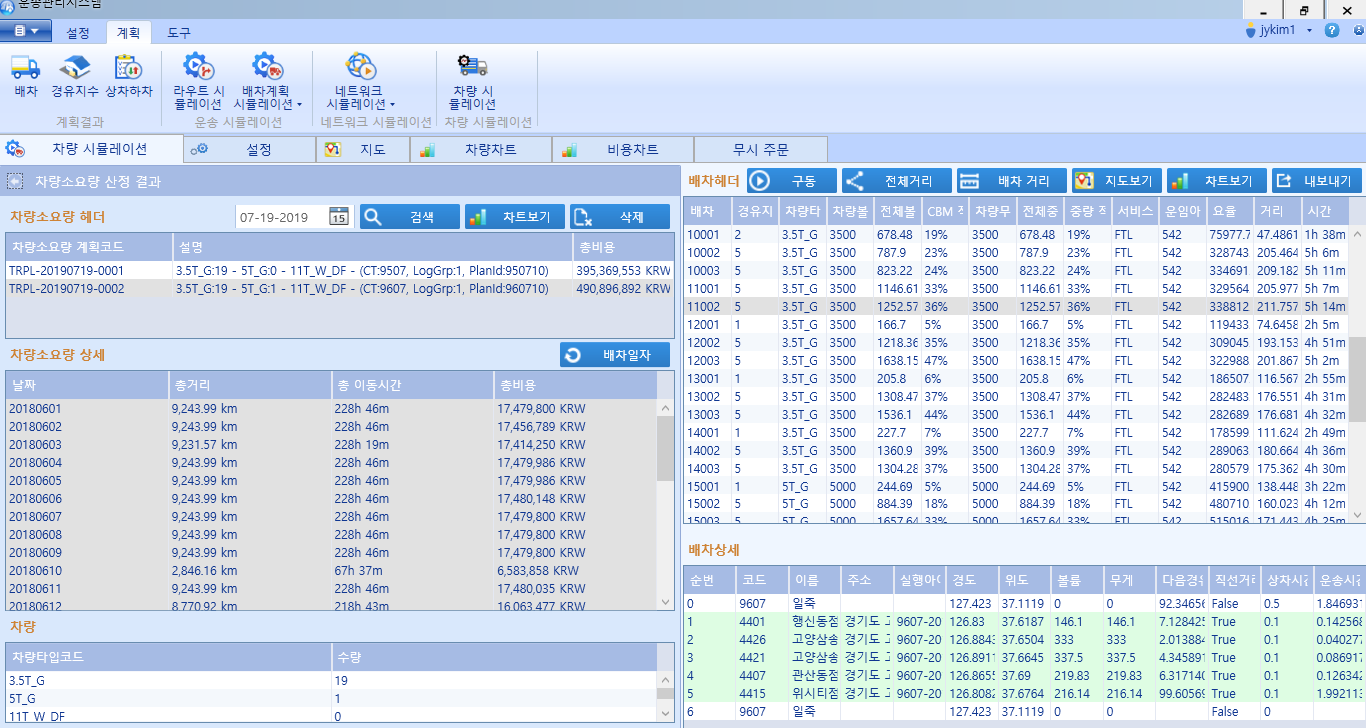
Please check the screen in the introduction material.
Daily vehicle and dispatch simulation results screen on page 37 of the G-TO introduction (October 2025). Differentiate the data on the screen and vehicle configuration from the recommended values in the example below. Click on the image to see it larger.
Original Korean source material. See the English explanation on this page.
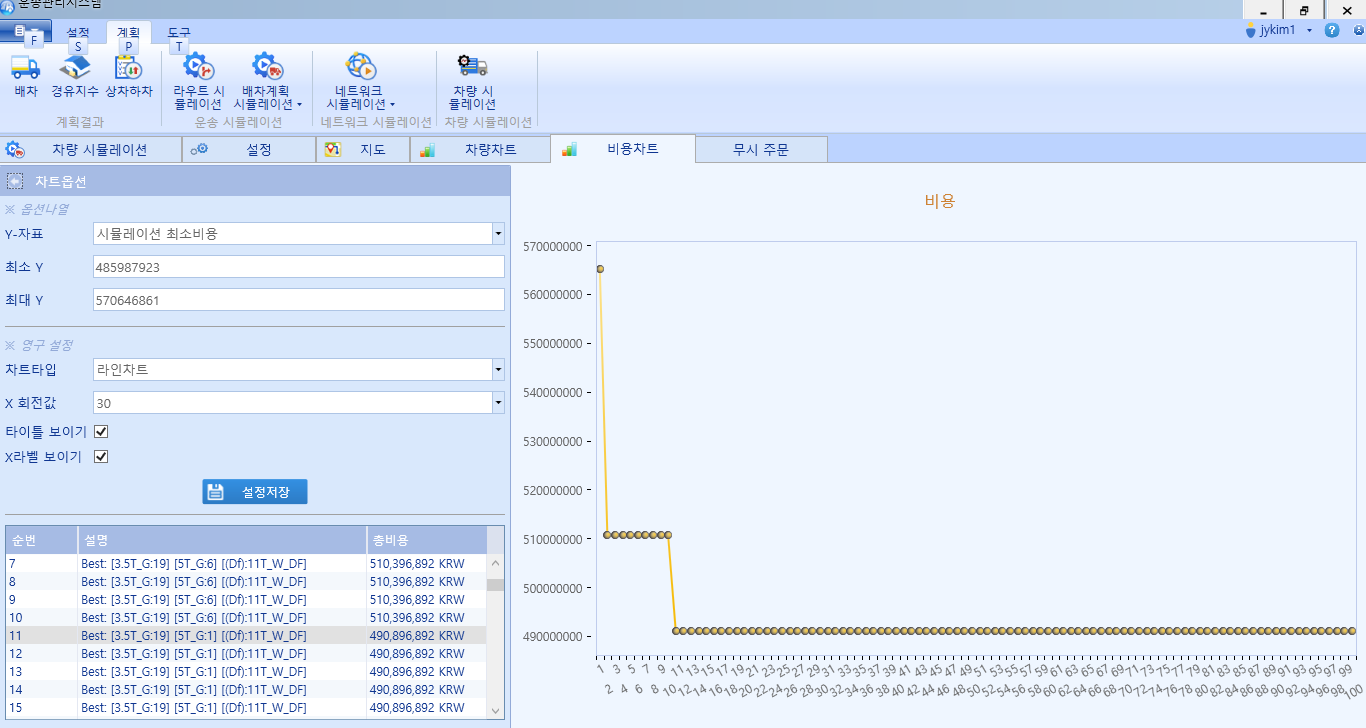
Cost comparison screen on page 37 of G-TO Introduction (October 2025). This is an example of functionality from past deployments and does not represent current operating costs or performance for all customers. Click on the image to see it larger.
Original Korean source material. See the English explanation on this page.
YOUR OPERATIONS / NEXT STEP
How do we apply dispatch and replanning to our work?
Please tell us about the most difficult situation in dispatch right now. We review the required data, site constraints, and scope of connection with existing systems.
Please choose a situation that is close to our company.
Having these materials will be helpful in your review.
Representative order/vehicle items
Operational restrictions such as delivery time and vehicle type
Current dispatch method and examples of changes
Even if you don't have any data yet, you can tell us about your current situation. Information that is difficult to disclose may be reviewed as a sample with identifying information masked.
In consultation, the scope is set as follows.
Check current work and improvement goals
Summary of data/constraints and comparative verification scope
Link to existing systems and discuss scope of construction
A 44-slide PowerPoint covering TMS project experience, optimization functions, transport and network simulation, and screenshots of earlier implementations.